
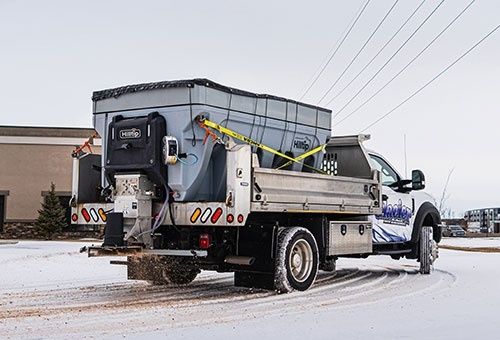
Why Mathematical Precision Beats Guesswork in Winter Gritting
Winter gritting is often judged by appearance: a surface looks white, a spinner is turning, and the operator assumes the setting is correct. That approach is unreliable. A dial number is not a universal application rate, and the same setting can discharge very different quantities when spreader models, salt grades, moisture content, walking or driving speed, and gate wear change. Under-application can leave ice untreated and expose owners, employers, contractors, and facilities teams to avoidable safety and liability risks. Over-application wastes material, increases clean-up requirements, accelerates corrosion, and sends excess chloride into drainage systems.
A calibrated operation replaces visual judgement with a measured target in grams per square metre, or g/m². The basic calculation is straightforward: weigh the material discharged over a known area, then divide product weight in grams by that area in square metres. The difficult part is keeping the application rate stable while conditions change. Ground speed determines how long the gate remains over each metre of pavement, while spread width, spinner speed, salt condition, and traffic all affect where the material lands. This guide provides a practical field protocol for facilities managers and gritting operators, supported by the principles in spreader calibration guidance.
- Measure output rather than relying on a dial number.
- Record application rates against pavement temperature, moisture, and traffic conditions.
- Recheck equipment after repairs, component wear, material changes, or extended storage.
- Use the lowest verified rate that delivers a dependable safety margin.
Catchment Tray Testing Protocols for Accurate Discharge Rates
A useful calibration test needs a controlled area, a known travel speed, accurate scales, and catchment equipment that captures the full discharge. Static tarpaulins can work for a quick operational check, but standardised catchment boxes or multiple shallow trays provide better information about distribution. The test surface should be level and clear of loose material. Mark the full effective spread width and a measured test length, then calculate the test area by multiplying those two dimensions. For a direct-drop machine, the effective width may be the hopper opening width. For a broadcast spreader, it must be the width over which the intended quantity is distributed, not merely the maximum distance reached by a few stray granules.
Before testing, inspect the hopper, agitator, shut-off mechanism, gearbox, spinner disc, deflectors, and tyres. Use the same salt grade and condition intended for the work. Damp salt can bridge above a gate or form lumps that distort the result, while very dry fine material can behave differently from coarse treated rock salt. Fill the hopper sufficiently to represent normal operating conditions, but do not allow the material level to fall so low that discharge becomes inconsistent. If the machine has adjustable throwing ports, balance left, right, and centre distribution before calculating the final rate.
- Place the trays or tarpaulins across the intended spread width and mark a measured test length.
- Weigh the material loaded into the spreader, or weigh the hopper before and after the test if that is more practical.
- Set the gate and spinner to the proposed operating position, then begin moving before opening the control lever.
- Travel the test length at the normal working speed. Keep the speed steady, because a slower pass increases the quantity applied per square metre.
- Close the gate before stopping, collect all material from the catchment area, and weigh it separately from any material outside the intended width.
- Calculate the rate using application rate in g/m² = product weight in grams divided by test area in square metres.
- Repeat the run at least twice and use the average only when the results are reasonably consistent. Investigate large differences rather than averaging away an equipment fault.
Broadcast patterns require additional interpretation. A tray near the centre may collect more salt than a tray at the edge, so a single container cannot establish the total rate or prove uniform coverage. Multiple trays across the width show whether the pattern is balanced and whether excessive spinner speed is creating a high central dose with thin edges. A direct-drop spreader normally gives a narrower and more predictable band, but it still needs testing because worn gates and compacted material can create uneven release. Calibration should be repeated when the product grade changes, after component replacement, and at regular intervals during the season.
Aligning Gate Settings with Road Surface Temperatures and Frost Severity
Salt performance depends on more than air temperature. Road surface temperature, residual moisture, frost severity, compacted snow, traffic, and available time for melting all influence the rate needed. A precautionary treatment applied before ice forms usually needs less material than reactive de-icing on an established compacted layer. The objective is not to make every surface visibly white with salt. It is to place enough material where moisture will freeze or where ice must be weakened, then allow time and traffic to activate the treatment.
The following matrix is an operational starting point, not a substitute for local trials, product instructions, or a site-specific risk assessment. Exact rates should be confirmed by catchment testing and adjusted for salt purity, particle size, pavement condition, exposure, and the consequences of a slip or vehicle loss of control.
| Road surface condition | Typical operational response | Indicative target approach |
|---|---|---|
| Above freezing with wet pavement and expected temperature fall | Precautionary treatment before freezing | Use a low verified rate sufficient to interrupt initial ice formation |
| Near freezing with frost risk and damp pavement | Preventive gritting or early treatment | Use a moderate tested rate, with priority given to shaded and exposed areas |
| Below freezing with active frost or thin ice | Reactive de-icing | Increase the verified rate and allow time for brine formation before mechanical removal |
| Compact snow or bonded ice | Mechanical scraping followed by de-icing | Do not expect salt alone to remove thick compacted layers; apply to the residual film after disturbance |
| Very low temperatures or rapidly refreezing moisture | High-risk treatment and monitoring | Use site-tested escalation procedures, physical removal, and repeated inspections rather than unlimited salt |
Municipal winter service plans are useful benchmarks because they formalise prioritisation, forecasting, treatment decisions, and contingency arrangements. For example, the Devon winter service and emergency plan describes a structured approach to keeping highway users reasonably safe, prioritising strategic and high-traffic routes while treating many footways and cycleways reactively. A private estate should not copy a council route hierarchy blindly, but it can apply the same discipline by ranking entrances, gradients, emergency access, pedestrian pinch points, loading areas, and shaded surfaces according to risk.
Factoring Traffic Agitation and Surface Dynamics into Spread Rates
Traffic changes how salt works after it lands. Tyres and footwear crush crystals, spread granules across the film of moisture, and help create brine at the pavement interface. This agitation can improve distribution on a busy estate road, particularly when the treatment is applied before or during a frost event. A lightly used walkway receives much less mechanical assistance, so it may require closer inspection, more even placement, brushing or scraping, and carefully controlled repeat applications rather than simply a large initial dose.
Application should therefore be separated by surface use and risk. A heavily trafficked access road may justify a different verified rate from a sheltered pedestrian route, even when both have the same surface temperature. However, traffic is not a reason to increase salt without measurement. Excessive spinner disc revolutions can cause bounce, wind displacement, and a concentrated central strip. Crosswinds can move lightweight particles away from the intended path, while vehicle speed can produce a narrow or irregular pattern. The operator should reduce spinner speed where the equipment allows, use deflectors correctly, and confirm the pattern with trays.
- Use a steady speed and avoid accelerating over high-risk areas.
- Open the gate only after movement begins and close it before stopping.
- Separate pedestrian, vehicle, ramp, loading, and emergency-access rates in the site plan.
- Inspect for uneven central loading, thin edges, wind drift, and untreated gaps.
- Keep salt dry and free-flowing. If moisture causes bridging, stop and clear the hopper safely rather than enlarging the gate indiscriminately.
Gate dimensions also matter. A narrow opening may give a precise rate with dry, uniform crystals but clog when salt absorbs humidity. Opening the gate much wider can release a surge that invalidates the calibration and leaves a heavy deposit at the start of the run. Corrective action includes improving covered storage, breaking up hardened material, checking agitator function, and recalibrating after any change. Equipment manuals commonly recommend a consistent brisk operating speed, often around three miles per hour for pedestrian broadcast units, but the critical requirement is not a universal speed. It is testing at the speed operators can maintain safely and consistently.
Mitigating Environmental Runoff and Infrastructure Damage Through Controlled Dosing
Chloride does not disappear when the pavement dries. Meltwater can carry it into gullies, streams, ponds, groundwater, and roadside soils, where repeated seasonal loading may persist. Elevated chloride can alter freshwater conditions and soil chemistry, affect vegetation, and contribute to the long-term degradation of drainage environments. Facilities with impermeable yards, steep falls, nearby watercourses, or shallow groundwater should treat salt storage and application as part of their water-management responsibility.
A detailed investigation by the USGS and the New York State Department of Transportation compared de-icing treatments across three watersheds and monitored highway runoff, surface water, groundwater, and pavement conditions. The USGS chloride runoff study found that chloride concentrations were generally higher downstream of highways than upstream, and that groundwater affected by historical de-icing could continue contributing chloride to surface water. The findings also show why a single rate rule cannot capture every site. Winter severity, hydrology, geology, pavement condition, adaptive management, and legacy application all interact.
Uncontrolled dosing also damages built assets. Chloride-laden water can accelerate corrosion of reinforced concrete where it reaches steel reinforcement, weaken the service environment around asphalt and joints, and promote corrosion on commercial vehicle chassis, dock equipment, barriers, and metal doors. The answer is not to compromise slip safety. It is to verify the dose, remove snow mechanically where practical, target high-risk zones, prevent drift into planted areas, and sweep residual material when weather conditions allow.
- Store salt under cover on an impermeable surface, with drainage managed away from watercourses.
- Map gullies, outfalls, planted borders, groundwater-sensitive areas, and concrete structures.
- Use calibrated rates by zone instead of treating the entire site at the highest-risk setting.
- Inspect treated areas after application and reapply only where the safety margin has genuinely deteriorated.
- Recover surplus salt during post-event sweeping and record unusual losses or wash-off.
Building a Dependable Cold-Weather Calibration Routine
A dependable calibration programme turns a spreader from a rough dispensing tool into a controlled application system. Verified g/m² rates make material consumption predictable, improve contractor accountability, support defensible winter maintenance decisions, and reduce the likelihood of both untreated ice and unnecessary chloride release. The process is especially valuable where several operators use the same equipment, because a written rate and speed standard removes ambiguity from handovers and night work.
- Before the season, inspect and service each spreader, confirm the intended salt grade, prepare trays and scales, and create a calibration sheet for every machine.
- Run a measured test at each principal operating speed and record gate position, spinner setting, spread width, material condition, and calculated g/m².
- At least weekly during active weather, complete a spot-check using the same test method, with additional checks after repairs, blockages, product changes, or unusual humidity.
- During operations, record pavement temperature, moisture state, treatment time, route or zone, applied rate, operator, and follow-up inspection result.
- After an event, compare material used with the treated area and investigate any difference that suggests leakage, drift, excessive overlap, or inconsistent speed.
Clear logs provide more than a purchasing forecast. They show that the site assessed conditions, selected a proportionate treatment, maintained its equipment, and inspected the result. That evidence supports internal review, contractor management, environmental reporting, and liability protection. With regular tray calibration and temperature-responsive decisions, winter maintenance becomes measurable, repeatable, and safer for people, infrastructure, and the surrounding drainage environment.