
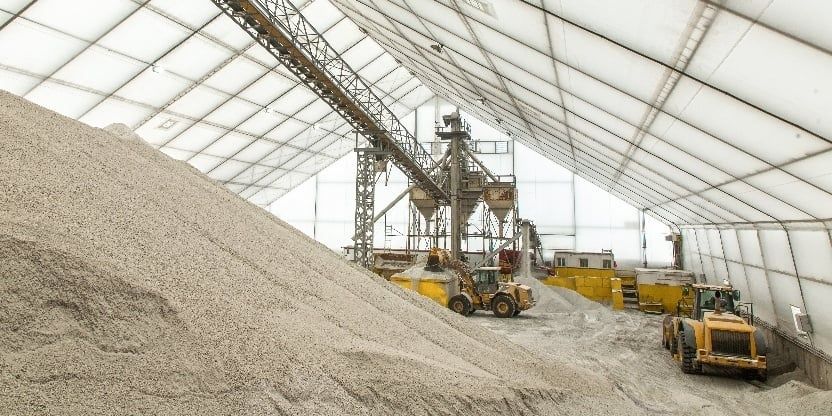
Managing the Winter Dilemma of Chloride Wastage and Machinery Failure
Bulk de-icing salt is essential winter infrastructure, but it is also highly sensitive to poor storage. Across UK highways depots, estates and commercial sites, repeated exposure to rain, condensation and damp ground can turn free-flowing rock salt into dense, compacted masses. At the same time, dissolved chloride can migrate through unprotected yards and reach drains, groundwater or nearby watercourses. The result is a dual operational problem: wasted material and an increased environmental risk.
Caking is not merely a housekeeping issue. A blocked hopper or bridged conveyor can take a gritter out of service when freezing conditions demand immediate deployment. Operators may need to stop, isolate machinery, break up hardened salt manually and clear damaged components. Corrosion adds a further cost through accelerated wear on augers, chains, gates, spreader discs and vehicle bodies. Effective storage therefore has to protect product quality, equipment availability and water quality at the same time.
- Use covered, impervious storage with a layout designed for local wind and rainfall conditions.
- Grade slabs and loading areas so contaminated water flows to controlled collection points rather than open drains.
- Select heavy-duty covers, secure them against wind and inspect them throughout the season.
- Keep a written inspection, cleaning and drainage maintenance record for operational and regulatory assurance.

Understanding Salt Hygroscopy and the Mechanics of Aggregate Caking
Sodium chloride is hygroscopic, meaning it can attract and retain moisture from the surrounding air. The risk increases when relative humidity remains high or when a pile experiences repeated wetting and drying. A thin film of moisture forms on individual crystals, partially dissolving their surfaces. When the material later dries, the dissolved salt recrystallises at contact points between particles. Those crystal bridges gradually bind the aggregate into lumps, crusts and, eventually, hard blocks.
Temperature cycling makes the process more difficult to manage. A cold pile can meet warmer, moisture-laden air when a shed door is opened, while rainwater can enter during loading or vehicle movements. Surface crusting may conceal wetter material underneath. Even if the outer face appears dry, internal pressure and compaction from loaders can create dense zones that do not flow reliably into a spreader. A covered store should therefore reduce both direct precipitation and uncontrolled air movement, while stock rotation limits the length of time salt remains exposed.
UK rock salt supplied to the BS3247:2011 specification commonly contains natural insoluble material. Winsford rock salt, for example, is described as more than 90% sodium chloride, with Keuper Marl contributing a protective thatching effect and additional friction during highway application. This natural fraction does not eliminate moisture-related caking. Prolonged damp exposure can still bind the salt and insoluble particles together, particularly where fines accumulate along walls, beneath stockpiles or in loading lanes.
The operational consequences are predictable but expensive. Large lumps can obstruct hopper outlets, overload augers and produce uneven application rates. Operators may receive little or no material from one side of a twin-auger system while the vehicle continues to run. Manual intervention also introduces safety risks, especially when staff climb onto piles or work around moving equipment. Anti-caking additives and low-moisture grades can improve flow, but they cannot compensate for water entering the stockpile. Storage remains the primary control.
Storage Bay Orientation and Foundation Engineering Specifications
Site design begins before the first load of salt arrives. Where practical, orient the open face of a bay away from prevailing wet winds, driving rain and the direction from which storms commonly approach. Wind exposure should be assessed at the actual site, taking account of nearby buildings, trees, hardstandings and changes in ground level. A bay that appears sheltered in summer may receive wind-driven rain through a wide entrance during winter storms.
Access must be balanced against protection. The entrance should be wide enough for safe loader and delivery vehicle movements, but unnecessary openings, damaged doors and poorly fitted curtains allow rain and snow to enter. Positioning the pile away from the entrance creates a practical buffer. Avoid placing the stockpile directly beneath roof edges where concentrated runoff can fall onto the cover or slab. The storage area should also be separated from clean surface-water routes wherever possible.
The foundation must prevent salt and brine from contacting vulnerable ground or migrating beneath the slab. A properly prepared sub-base should support the expected stockpile and vehicle loads without settlement. Positive falls are important: the guidance specified for this project is a fall of 1:40 away from the stockpile core, directing liquid toward controlled collection or treatment points. Drainage should never simply discharge saline water into an adjacent surface-water drain without checking the applicable permit and local requirements.
Concrete protection is equally important. Chloride solution can penetrate cracks, joints and porous surfaces, accelerating reinforcement corrosion and freeze-thaw damage. Specify a durable, compatible surface treatment such as a silane-siloxane system or a high-density epoxy sealant after confirming suitability with the concrete condition, traffic loading and manufacturer”s installation requirements. Joints, penetrations and wall-to-slab interfaces require particular attention because they are common leakage paths. Depot managers planning structural upgrades should review the engineering specifications in the Salt Shed Design Template to support durable, environmentally responsible design.
| Design feature | Operational purpose | Inspection focus |
|---|---|---|
| Wind-aware bay orientation | Reduces driving rain and snow entering the store | Check seasonal wind exposure and damaged screens |
| Impermeable sealed slab | Limits chloride penetration into concrete and subsoil | Inspect cracks, joints, spalling and coating wear |
| Positive surface falls | Moves brine toward controlled collection points | Confirm falls remain clear and are not blocked by salt |
| Bunds and collection points | Separates contaminated water from clean runoff | Remove sediment and verify sump capacity |
Sheeting Protocols and Heavy-Duty Moisture Barrier Selection
Where salt is stored outdoors temporarily, or where a building cannot provide complete weather protection, sheeting must be treated as an engineered moisture barrier rather than a loose tarpaulin. Woven polypropylene can provide a practical combination of flexibility, tear resistance and manageable weight. Reinforced PVC is generally selected where a heavier, more abrasion-resistant cover is required. Compare tensile strength, puncture resistance, ultraviolet stability, seam construction and GSM weight against the pile size and handling method. The cheapest cover is rarely economical if it splits after one storm.
The cover should be large enough to reach well down the sides of the stockpile, while leaving an arrangement that permits inspection and controlled access. Covering only the top ridge allows rain to run down exposed faces and can concentrate water at the pile base. Do not place the sheet directly over sharp salt projections, broken pallets or metal edges. A sacrificial protective layer or rounded pile profile reduces puncture risk. Any ventilation system must prevent rain ingress while allowing trapped moisture and condensation to escape.
Installation should follow a consistent sequence. The aim is to prevent wind buffeting, open seams and low points where water can pool.
- Shape the stockpile into a stable, peaked profile and remove sharp protrusions from the surface.
- Position the main cover centrally, allowing generous overlap down each side and at every joint.
- Fold and secure overlaps so that the upper sheet sheds water over, rather than beneath, the lower sheet.
- Install ballast or tie-downs at regular intervals using systems that do not tear the fabric or damage the slab.
- Check the perimeter after strong wind, heavy rain, loading activity and any movement of the pile.
Inspection should be scheduled rather than left to chance. Look for condensation beneath the cover, sagging sections, lifted edges, split seams, abrasion marks and water collecting at the base. A small tear can enlarge rapidly when the sheet moves in wind. Repair materials must be compatible with the cover and applied to clean, dry surfaces. The operational standard should also cover loading discipline: keep loaders from dragging the sheet through salt, and reseal the stockpile immediately after access.
Although the referenced road-salt rules are from Wisconsin rather than the UK, they provide a useful benchmark for the principle that bulk salt should be on an impermeable surface, securely covered and maintained in good repair. The Road salt Trans 277 and Salt Bid Information also illustrates how storage controls can be tied to registration, setbacks and protection of surface and groundwater. UK operators must apply the equivalent requirements set by their local planning, drainage, environmental permitting and pollution-control authorities.
Runoff Containment and Environmental Compliance for Highways Depots
Salt runoff is not harmless simply because sodium chloride is a familiar road material. Concentrated brine can degrade soil structure, stress vegetation, affect freshwater organisms and contaminate surface water or groundwater. In the UK, discharge to a watercourse, sewer or the ground may require consent, an environmental permit or agreement with the relevant water and environmental authority. Requirements vary by location and site arrangement, so depot teams should obtain site-specific advice rather than assume that an existing yard drain is suitable.
The preferred arrangement separates clean water from contaminated water. Roof water and runoff from areas outside the salt-handling zone should be diverted wherever practicable. Water from the stockpile, loading apron and washdown area should instead be directed toward a sealed drainage system. Perimeter bunding can prevent brine spreading beyond the operating area, while kerbs, channel drains and catch basins intercept liquid before it reaches uncontrolled outlets. A dedicated leachate sump provides temporary storage and allows inspection, pumping or treatment.
- Inspect bunds for cracks, settlement, vehicle damage and blocked low points.
- Keep catch basins free from salt crust, sediment, litter and ice.
- Mark isolation valves clearly and confirm that staff know how to close them during a spill.
- Size sumps for expected rainfall, stockpile drainage and emergency containment, using a competent engineer where required.
- Record pump-outs, inspections, incidents and disposal or reuse decisions.
Collected brine should be treated as a controlled resource, not an automatic waste stream. After checking concentration, contamination and equipment compatibility, suitable drainage brine may be reused in pre-wetting systems. Pre-wetting improves salt adhesion to the road and can support more consistent spreading, but it must be managed with calibrated equipment and an appropriate application plan. Concentrated liquid containing silt, oil or other contaminants should not be introduced into spreaders without assessment, because it may damage pumps, block nozzles or create an uneven treatment rate.
Training and calibration are central to reducing chloride losses. The Minnesota Pollution Control Agency”s Smart Salting programme reports that participating organisations have reduced salt use by 30 to 70 percent through better application, storage, equipment and planning practices. Although the programme is not UK legislation, its practical principles are transferable: map chloride sources, calibrate spreaders, match rates to weather and pavement conditions, and use storage controls as part of a complete pollution-prevention system.
Securing Depot Efficiency and Environmental Safety Ahead of Winter
A reliable bulk salt store is built around four linked safeguards: a weather-aware layout, a sealed and properly graded foundation, a cover that remains secure throughout the season, and drainage that captures contaminated water. Each measure supports the others. A strong cover cannot compensate for a cracked slab, and a sealed slab cannot prevent caking if rain enters through an unsecured entrance. The target is a dry, free-flowing product that reaches the spreader at the intended rate without avoidable environmental loss.
Before the 2026 to 2027 winter season, estate managers and depot leads should complete a documented audit rather than rely on visual checks made during an emergency.
- Confirm stockpile capacity, delivery access and safe separation from clean drainage routes.
- Inspect the slab, wall bases, joints, coatings, bunds, channels, catch basins and sumps.
- Check cover dimensions, tensile condition, seams, ballast and tie-down points.
- Test isolation valves, pumps, alarms and brine collection arrangements.
- Calibrate spreaders, review pre-wetting equipment and remove residual caked salt from hoppers.
- Brief operators on spill response, manual handling, equipment isolation and inspection reporting.
Systematic moisture control reduces more than material wastage. It limits unscheduled machinery downtime, lowers corrosion-related maintenance, improves spreading consistency and helps preserve emergency response capacity during prolonged frost. It also gives the depot a defensible record of good practice when environmental performance, drainage arrangements or winter-service resilience are reviewed. With appropriate design and disciplined daily handling, bulk salt remains a dependable operational material rather than a recurring source of caking, repair costs and saline pollution.